Aircon servicing & chemical wash price in Singapore
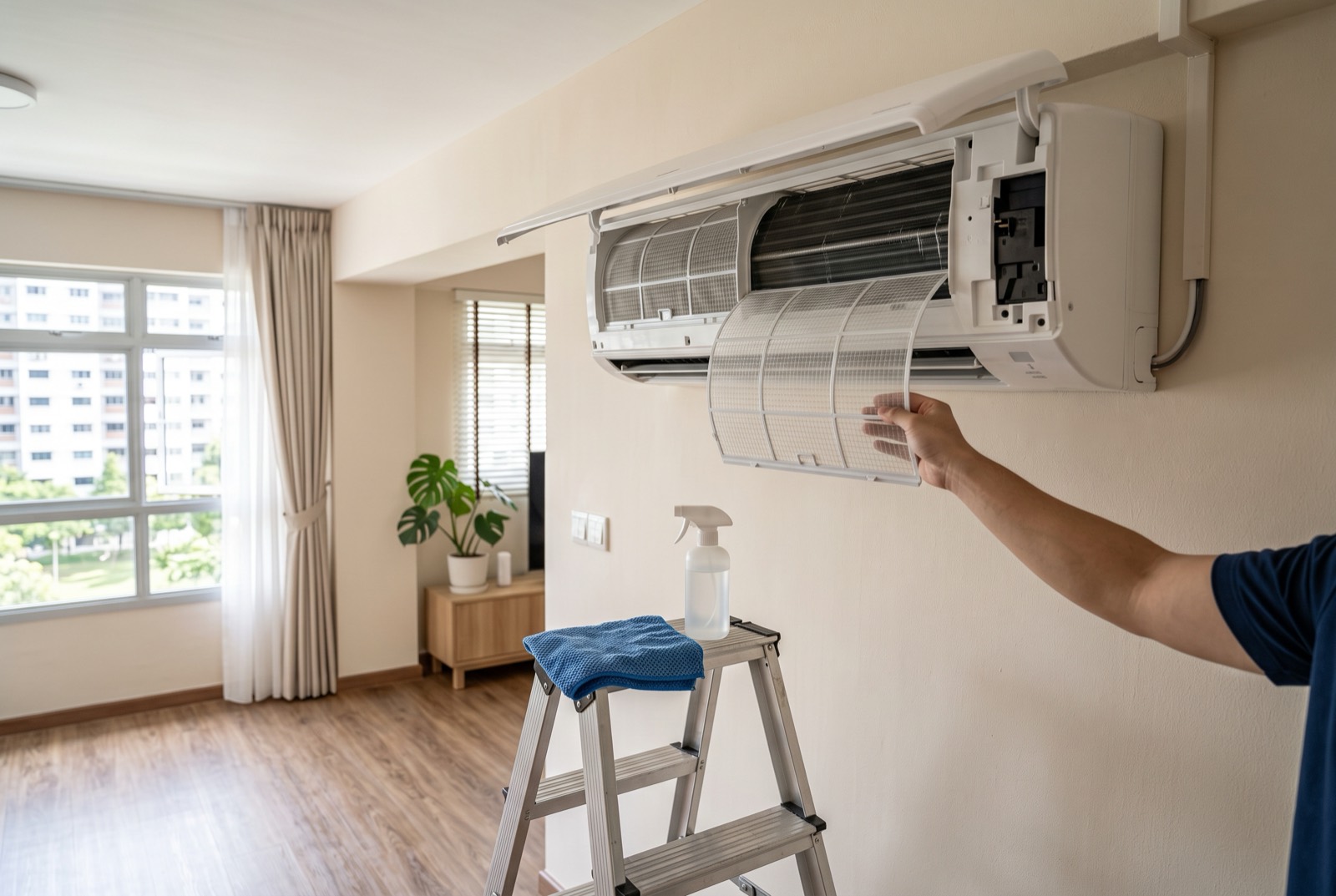
Wondering what aircon servicing cost in Singapore actually looks like in 2026? A standard aircon cleaning is cheap per unit, on recent RK E&C jobs it works out to about $25 per unit, so a typical 4-unit HDB flat comes to around $100 for the visit. Chemical work costs more, and if your aircon is leaking water or blowing weak, cool air, you may also need drainage clearing or a gas top-up. This guide breaks down the aircon cleaning price in Singapore, how often to service, why an aircon leaks, and when refrigerant needs topping up.
How much does aircon servicing cost in Singapore?
Pricing is by unit, not by hour, and almost every company applies a minimum trip charge. That is why servicing every unit in one visit is far cheaper per unit than calling someone out for a single blower. The table below shows recent RK E&C jobs alongside the indicative Singapore market range. Treat the ranges as a guide and always confirm a fixed quote before the visit.
| Job | Indicative price (SGD) | Notes |
|---|---|---|
| Standard aircon cleaning (per unit) | ≈ $25 / unit | Recent RK E&C job: 4 units = $100 |
| Leaking unit, diagnose, service & gas top-up if required | ≈ $60 – $150 / unit | Gas top-up adds cost on top |
| Chemical wash (per unit) | $60 – $120 / unit | For weak cooling or mouldy smell |
| Chemical overhaul (per unit) | $120 – $200 / unit | Deepest service; badly choked units |
| Gas (refrigerant) top-up | $80 – $150 / unit | Priced after pressure is checked |
| Pressure / leak test | $50 – $100 / unit | Finds where the gas is escaping |
| Gas leak repair (trace, repair, recharge) | $150 – $350 / unit | The durable fix, not just a refill |
| Repair: capacitor, fan motor, drainage pump, PCB | $80 – $400 | Part-dependent; quoted after diagnosis |
| Servicing contract, 4 quarterly visits | $180 – $320 / year | Typical 3 to 4 unit HDB flat |
The numbers above are anchored to real RK E&C jobs and framed as indicative. Your final price depends on how many units you have, their condition, and whether the work is a simple clean or a chemical treatment with gas. The single biggest way to save: bundle all your units into one appointment so the trip charge is spread across the whole job.
General cleaning vs chemical wash vs chemical overhaul
These three are often confused, but they are very different levels of work, and priced accordingly.
General cleaning (routine maintenance)
The everyday service. The technician vacuums and washes the filters, wipes the coils and fan blades, clears the drainage pipe and tray, and checks the gas pressure. This keeps airflow and cooling steady and is what most homes need on a regular cycle. It is the $25-per-unit tier on recent jobs.
Chemical wash (deeper clean)
When general cleaning no longer restores cooling, or the unit smells musty, a chemical wash is the next step. Chemical solution is applied to the fan-coil parts to strip built-up dirt, mould and grime that plain wiping cannot reach. It is used when a unit is choked, cooling weakly, or has been neglected for a long time.
Chemical overhaul (the deepest service)
The most thorough option. The fan-coil unit is largely dismantled (blower wheel, coil, tray and casing removed and cleaned individually) then reassembled. It is reserved for badly choked units, older systems, or a flat being prepared for sale. It costs the most and is quoted on site.
Aircon chemical wash price in Singapore
A chemical wash runs $60 to $120 per unit in 2026, and the spread inside that range is almost entirely about how choked the unit is and how many units you do in one visit. Two units on one trip sit near the bottom of the range; a single badly neglected blower on its own sits at the top.
What you are paying for, versus a $25 general clean:
- Chemical solution on the fan coil, dissolving the compacted dust, mould and biofilm that a vacuum and a wipe cannot shift.
- The blower wheel cleaned properly. This is the part that matters most for airflow, and it is the part a quick clean skips.
- Drainage tray and pipe flushed with chemical rather than just rodded.
- Coil fins combed and rinsed, restoring the airflow path.
A chemical wash is the right call when a general clean no longer brings the cold air back, when there is a musty or sour smell every time the unit starts, or when the unit has gone more than a year without service. It is not a routine service and you should not need one every quarter. If you are being sold a chemical wash at every visit, you are being sold the wrong thing.
Where a chemical wash stops being enough, the next step up is the chemical overhaul at $120 to $200 per unit, where the fan coil is dismantled and each part cleaned separately. That is for badly choked or older systems, or a flat being prepared for sale or handover. Our move-out cleaning checklist covers where aircon servicing sits in a handover.
Servicing rates: one-off visits or a contract
Two ways to buy the same work, and the right answer depends on how many units you have.
| One-off visit | Quarterly contract | |
|---|---|---|
| Typical cost | ≈ $25 / unit, trip charge applies | $180 – $320 / year for 3 to 4 units |
| Cost per visit | Higher, you pay mobilisation each time | Lower, spread across the year |
| Best for | 1 to 2 units, or occasional use | 3+ units in regular daily use |
| Risk | Easy to forget until it is choked | Paying for visits a lightly used flat does not need |
The deciding factor is the trip charge. Because almost every company applies a minimum call-out, a single unit serviced on its own is the most expensive way to buy this work. Four units in one visit at about $25 each is roughly $100, which is why bundling beats any contract discount if you are organised enough to book it yourself.
Aircon repair cost: what actually breaks
Servicing and repair get quoted together but they are different jobs. Servicing is maintenance on a working unit. Repair is a component that has failed, and it is priced after diagnosis rather than per unit:
- Drainage pump or float switch, $80 to $180. The usual cause of a unit that trips off or keeps leaking after a clean.
- Capacitor, $80 to $150. Compressor hums but will not start, or the outdoor fan does not spin.
- Fan motor, $150 to $350. Noisy blower, weak airflow with clean filters.
- Control PCB, $180 to $400. Unit unresponsive or throwing error codes. Often close to the point where replacement makes more sense.
The honest rule: once a repair on an older system approaches half the cost of a new unit installed, replacing it is usually the better spend. Ask for the diagnosis and the part cost separately, so you can make that call rather than being told a number.
Gas leak repair and the pressure test
This is where the biggest money is wasted in aircon work, so it is worth understanding before you agree to anything.
Refrigerant sits in a sealed loop. It is not consumed in normal running, so if the gas is low, it is leaking. A top-up at $80 to $150 per unit restores cooling, but if nobody has found the leak you are buying the same top-up again in a few weeks or months. That is the cycle a lot of homeowners get stuck in.
The way out is a pressure or leak test at $50 to $100 per unit, which pressurises the system to find where it is escaping, usually a flare joint, a corroded coil or a damaged section of pipe. Once located, gas leak repair at $150 to $350 per unit covers tracing, repairing the joint or section, vacuuming the system and recharging it properly.
So the choice is between about $100 repeatedly and about $250 once. If a technician offers a top-up without proposing to find the leak, ask why. On a unit that has needed gas twice, a test is not an upsell, it is the cheaper path.
How often should you service your aircon?
Singapore's climate is hot and humid year-round, so aircons work hard and clog faster than in cooler countries. As a rough guide:
- General cleaning every 3–4 months for a normal home keeps filters and coils clear.
- More often if you run the aircon heavily, live near a dusty road, or have just finished renovation.
- Chemical wash once or twice a year, or whenever a general clean stops restoring the cold air.
Skipping servicing is a false economy. A choked unit runs longer to reach the same temperature, uses more electricity, and eventually leaks or fails. Singapore's National Environment Agency (NEA) also recommends keeping cooling systems and filters clean for better indoor air quality, since a dirty fan-coil unit circulates dust and can harbour mould.
Why is my aircon leaking water?
A dripping aircon is one of the most common call-outs we get, and it is almost always a drainage problem, not a broken unit.
- Choked drainage pipe or tray. Your aircon produces condensation, which drains away through a pipe. Over time dust, dirt and algae block that pipe or the tray under the coil, so water backs up and drips out of the fan-coil unit onto your floor or wall.
- Dirty evaporator coil. A heavily fouled coil can cause condensation to form and drip in the wrong place instead of running into the tray.
- A slightly tilted unit. If the fan-coil unit is not level, water runs to one side and overflows rather than draining.
The fix during a proper service is to clear and flush the drainage and clean the coil so condensation drains normally again. If the leak comes back quickly, the pipe or tray may need deeper cleaning, or the unit may need realigning, worth flagging when you book so we bring the right kit.
Weak cooling and gas (refrigerant) top-up
If your aircon switches on and the fan runs, but the air is only mildly cool despite clean filters, the system may be low on refrigerant, the "gas" that carries heat out of the room. A top-up restores the pressure and the cold air.
One important point: refrigerant is a sealed loop and does not get "used up" in normal running. So if the gas is low, there is usually a leak somewhere in the system. A good technician traces and addresses the leak rather than just refilling. Otherwise the fresh gas escapes again and you are back to weak cooling in a few weeks. A gas top-up is an added cost on top of the servicing visit, and it is only quoted once the pressure has been checked on site.
Persistent weak cooling can also point to a choked coil that needs a chemical wash, so it is worth having the unit inspected rather than assuming it is only gas.
Signs your aircon needs servicing now
- Water dripping or staining below the fan-coil unit
- Air is running but the room no longer gets properly cold
- A musty or sour smell when the aircon starts up
- Weak airflow, or ice forming on the unit
- Noticeably higher electricity bills for the same usage
- It has simply been more than 3–4 months since the last service
HDB and condo: what to know
For routine servicing, cleaning, drainage clearing or a gas top-up inside your flat, you do not need an HDB permit. Permits apply to installing a new system or works affecting the external wall and ledge, not maintenance. Two practical notes:
- Access to all units. Clear a little space under each fan-coil unit so the technician can lay down sheets and reach the drainage.
- Noise hours. Keep any drilling or noisier work within HDB's permitted hours to stay on good terms with neighbours.
Getting it done by RK E&C
RK E&C is a Singapore-registered renovation and handyman company (UEN 202442767D) that services and cleans aircons in HDB flats and condos island-wide: general cleaning, chemical wash, leak and drainage fixes, and gas top-ups. We can do it as a standalone job or alongside other handyman and renovation work in the same visit. If the problem is the pipework rather than the units, see our guide to aircon piping replacement and installation costs. Related guides: fixing a leaking tap in your HDB and our HDB renovation cost breakdown. You can also browse all our guides.
Tell us how many units you have and your postal code, and we'll quote you, usually the same day.
Aircon dripping or not cold enough?
Tell us how many units and your postal code. Fixed-price quote, cleaning, leak fixes and gas top-ups, island-wide.
Prices are anchored to recent RK E&C jobs and indicative of the Singapore market in 2026, not a quotation. Confirm a fixed price before work begins.