HDB hacking & demolition: what's allowed, permits and cost
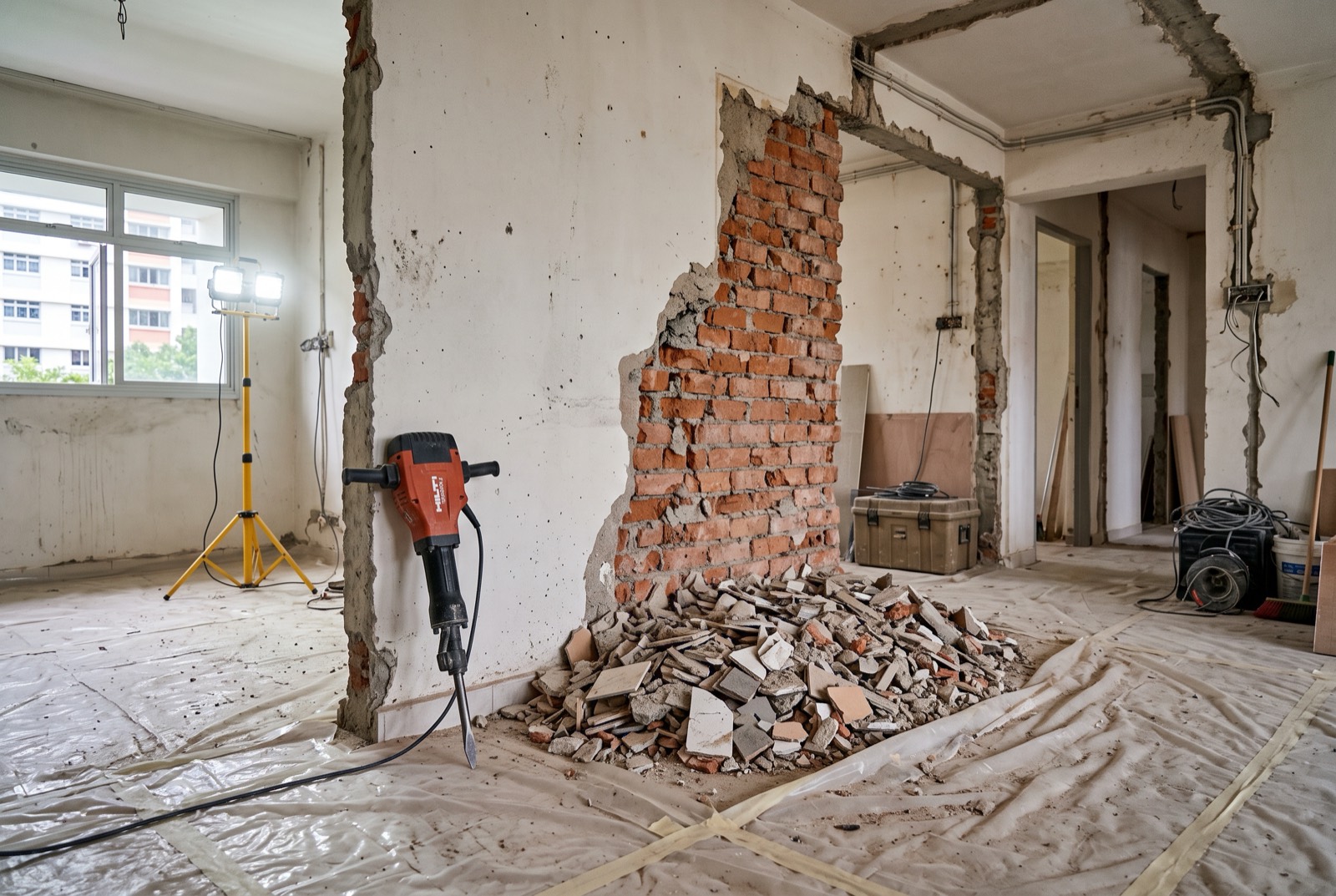
Planning to open up a wall, rip out old tiles or strip a flat back before a fresh renovation? In an HDB flat, most HDB hacking and demolition work needs a renovation permit and must be done by an HDB Registered Renovation Contractor, and some things, like structural walls and the household shelter, can never be touched at all. This guide explains what you can and cannot hack, how the permit works, the permitted hours, how debris is disposed of, and the indicative cost of hacking in Singapore.
Do you need a permit for HDB hacking?
In almost all cases, yes. HDB requires a renovation permit for hacking and demolition works, and that permit can only be applied for through an HDB Registered Renovation Contractor, you cannot DIY-hack a wall and sort the paperwork later. The contractor submits the works to HDB, and only approved works may be carried out.
Skipping the permit is not worth it: unauthorised hacking can lead to enforcement action and an order to reinstate the flat at your own cost. The current list of what needs a permit, and the application process, is published on the official HDB website, and the rules are updated from time to time, so always confirm before you start.
A few practical points worth knowing before you book any hacking:
- The permit is tied to the specific works submitted. If your design changes part-way, say you decide to remove an extra wall, that change needs to be cleared too, not slipped in quietly.
- The flat owner remains responsible for the works even though the contractor applies. That's another reason to use a contractor who actually knows the rules rather than the cheapest quote.
- Newer flats may sit within a minimum occupation or defects-liability context where certain works are restricted. If your flat is recently collected, check what applies before hacking anything.
What can and can't be hacked in an HDB flat
The single most important rule: structural elements can never be hacked. Everything else depends on whether the work is approved. The table below sums up the common jobs we get asked about.
| Common hacking job | Allowed? | Notes |
|---|---|---|
| Remove a non-structural partition wall | Yes, with permit | Only non-load-bearing walls; permit required first |
| Hack floor / wall tiles | Yes, with permit | Within permitted hours; debris must be disposed properly |
| Hack the household shelter (bomb shelter) | No, never | Protected civil-defence structure; shelter door must stay intact |
| Hack a structural wall, column or beam | No, never | Carries the building's load; removing it is strictly prohibited |
| Cut a new opening in a reinforced concrete wall | No, never | Treat RC walls as structural; no openings allowed |
If you are not sure whether a wall is a flimsy partition or a load-bearing structure, do not touch it. A registered contractor can tell you, and structural questions ultimately fall under the building-works rules overseen by the Building and Construction Authority.
What is structural and can never be hacked
Structural elements hold up your flat and the units above you. Tampering with them risks the safety of the whole block, so HDB simply does not allow it. These can never be hacked, drilled through, notched or removed:
- Reinforced concrete (RC) walls. In most HDB flats these are load-bearing. As a rule of thumb, treat any RC wall as off-limits.
- Columns and beams. These transfer load to the foundations, no cutting, no openings.
- The Household Shelter (HS). The shelter's walls, ceiling, floor and its HS door are part of a civil-defence structure. They must never be hacked, drilled into or removed, and the shelter must stay clear and accessible.
- Floor slabs. You cannot cut through or sink works into the structural slab.
Only non-structural partition walls, lightweight walls that carry no load, may be removed, and only once HDB has approved the work. Even then, there can be limits on how much wall length may be removed in a given area, so the open-concept layout you have in mind may need to be checked against what's actually allowed for your block.
Why the strictness? An HDB block is one connected structure. A wall you treat as "just a divider" might be carrying the unit above. Cutting an opening into it, or notching it for pipes, can quietly compromise the load path in a way no one sees until it matters. That's why structural questions are governed under the building-control regime that the BCA oversees, not left to on-site judgement.
Permitted hacking hours and timeframe
Hacking and demolition are noisy, so HDB limits when they can happen and how long the noisy phase can run. The exact timings are set by HDB and can change, but the principles are steady:
- No noisy work on Sundays and public holidays. Hacking and drilling are confined to weekday and Saturday daytime hours.
- A limited noisy-works window. The most disruptive demolition and hacking must be completed within a short window after the permit is issued, not dragged out over weeks.
- Be considerate to neighbours. Even within permitted hours, good contractors warn neighbours before heavy hacking days.
Check the current permitted hours on the HDB website before scheduling, and build the hacking phase early in your renovation timeline.
Debris disposal: done properly
Hacking produces a surprising amount of rubble, and it cannot just be left at the void deck or pushed down the refuse chute. Proper disposal is part of the job:
- Debris is bagged and carted out of the block, not dumped on common property.
- It is sent to an approved disposal point, not mixed with household refuse.
- Lifts and corridors are protected, and common areas are swept clean afterwards.
Disposal is usually quoted either inside the hacking price or as a separate line item by volume of rubble. Confirm which before work starts, so there's no surprise bill at the end.
Why use an HDB Registered Renovation Contractor
For hacking, this isn't optional. Only a registered contractor can apply for the permit. Beyond the paperwork, it protects you:
- They know which walls are structural and which can be removed, so you don't accidentally weaken the flat.
- They keep the work inside permitted hours and the approved scope, avoiding enforcement headaches.
- They carry the right insurance and handle disposal the right way.
- They can sequence hacking with the rest of your works. See our guide on how to choose a renovation contractor in Singapore.
How much does HDB hacking cost?
Pricing depends on the area, the tile or wall type, access and how much rubble comes out. The figures below are indicative of the Singapore market in 2026. Treat them as a starting point, not a quotation, and always get a fixed price first.
- Hacking floor or wall tiles. Often from a few hundred dollars per area, rising with floor size and tile thickness.
- Removing a non-structural partition wall. Typically a few hundred dollars per wall, depending on length and material.
- Debris disposal. Usually charged on top, by volume of rubble carted out.
Hacking is one early line in a much bigger budget, for the full picture, see our breakdown of HDB renovation cost in Singapore.
Getting it done by RK E&C
RK E&C is a Singapore-registered demolition and renovation company (UEN 202442767D) that handles HDB hacking, tile removal and partition demolition island-wide: with permits applied for the right way, work kept inside HDB's permitted hours, and rubble disposed of properly. It can run as a standalone hacking job or as the first phase of a full renovation and demolition package.
Send us photos of the walls or tiles you want hacked, plus your postal code, and we'll advise what's allowed and give you a fixed quote, usually the same day.
Planning hacking works?
Send us photos and your postal code. We'll tell you what HDB allows, sort the permit, and quote a fixed price, disposal included, island-wide.
Prices are indicative of the Singapore market in 2026 and not a quotation. HDB rules are updated from time to time. Always confirm the current renovation guidelines on the HDB website and with your registered contractor before work begins.