Full HDB renovation cost: a real $38,000 project, itemised
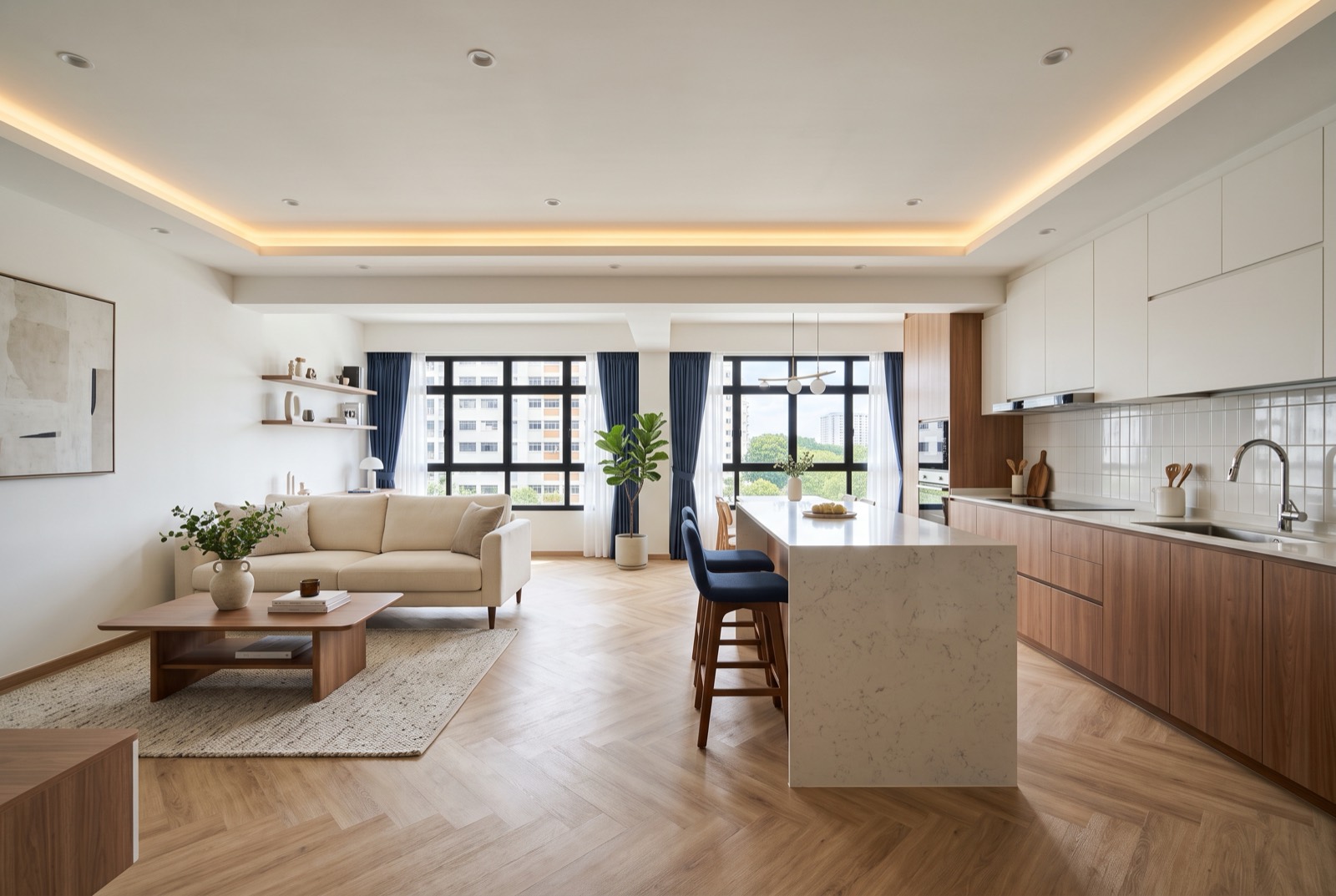
If you want to know the real full HDB renovation cost before you plan your own, here is one honest, complete example. A whole-flat renovation RK E&C started in December 2025 in Bukit Panjang came to S$38,330, and this article lays out every single line item and explains what actually drives each cost. It is not a marketing round number: it is the full itemised job, from kitchen hacking to the final sliding door.
This kind of renovation cost breakdown is exactly what most Singapore homeowners struggle to find. Quotes get bundled into a vague "package price" with no visibility into where the money goes, which makes it impossible to compare fairly or to know whether you are overpaying. So we're showing a real project in full. Note upfront: in this job the client supplied the tiles, sanitary accessories, light fittings and fans, and the switches were Schneider, that keeps some numbers lower than a job where the contractor supplies everything, and we explain how that trade-off works.
The full breakdown: every line item
Here is the complete scope of works for the Bukit Panjang flat, exactly as it was quoted and completed. Figures are in Singapore dollars.
| Item | Cost (S$) |
|---|---|
| Kitchen hacking | 1,500 |
| Kitchen plaster & floor levelling | 1,800 |
| 2 toilets, floor waterproofing & tile fixing (tiles supplied by client) | 5,400 |
| Room, new brick wall & door-side wall | 550 |
| Full-house plaster | 3,900 |
| Ceiling & cotton pelmet | 4,450 |
| Plumbing, hot & cold water lines, toilet & kitchen accessories fixed (accessories by client) | 3,600 |
| Electrical, LED lights, data point, switch/power points, Schneider brand (light & fan by client) | 4,800 |
| TV wall / door top cover | 480 |
| Painting | 1,800 |
| Electrical (additional) | 850 |
| Vinyl flooring | 5,200 |
| Moving furniture | 200 |
| Sliding door | 3,800 |
| Total | 38,330 |
Where the money actually goes
Five items make up the bulk of the cost. Understanding why each one is priced the way it is will tell you more about your own budget than any package quote.
Toilet waterproofing & tiling: S$5,400
Two toilets, done properly, is the single most labour-intensive part of most flats. Even though the client supplied the tiles, this line covers screeding, applying and curing the waterproofing membrane, the ponding test, and the careful tile-fixing that determines whether your toilet stays dry for the next fifteen years. Wet-work cannot be rushed: the membrane needs proper drying time, and skilled tilers are the difference between clean grout lines and a job you look at every morning and regret. This is not a corner to cut. For a deeper look at just this scope, see our HDB toilet renovation cost guide.
Vinyl flooring: S$5,200
Flooring covers the entire liveable area of the flat, so it scales with square footage more than almost anything else. This figure is for supply and installation of vinyl across the whole home. Vinyl is popular because it is warm underfoot, water-resistant and quick to lay over a properly levelled base, but "properly levelled" is the catch. The kitchen floor levelling earlier in the list exists partly so the vinyl sits flat and doesn't telegraph every bump underneath.
The main reason this line is higher than a typical vinyl job is the herringbone layout. A straight plank lay is fast; herringbone means every piece is cut and set at an angle, so it takes far more labour, more careful setting-out and more offcut wastage than laying planks in straight rows. Expect a clear premium over straight-lay vinyl for the same floor area. You're paying for the pattern and the time, not just the material. Larger flats such as a 5-room push the number up further simply because there is more floor to cover.
Electrical: S$4,800 (plus S$850 additional)
Electrical work is priced by the number of points, not by area. This covers LED lights, a data point, and switch and power points throughout the flat, using Schneider-brand switches and sockets. Better-brand accessories cost more but are worth it on something you touch every day and rarely replace. The separate S$850 "additional electrical" line is honest scope that came up during the job, extra points or changes the client asked for once walls were open. Rewiring and adding points is far cheaper to do now, while the flat is stripped, than to retrofit later.
Ceiling & cotton pelmet: S$4,450
This is the false ceiling and the recessed cove (the "cotton pelmet") that hides curtain tracks and lets you run concealed lighting. It is carpentry-grade work in plasterboard: framing, boarding, jointing and a flush finish across the whole flat. It's a big number because it touches every room's ceiling line and has to be dead level. If you want to understand this scope on its own, our false ceiling and cove lighting guide goes into it.
Full-house plaster: S$3,900
Plastering is another whole-flat, area-based cost. Every wall that will be painted needs to be skim-coated smooth first, and the quality of the plaster is what makes paint look flawless rather than patchy. Combined with the kitchen plaster and levelling, this is the invisible layer that everything else sits on, get it wrong and no amount of good paint hides it.
The smaller items add up too
The sliding door at S$3,800, plumbing at S$3,600 for hot and cold water lines with client-supplied accessories fixed, kitchen hacking at S$1,500, and painting at S$1,800 round out the major spend. Even small lines like the new brick wall (S$550), the TV wall and door top cover (S$480), and moving furniture (S$200) are real costs that a vague package quote would simply absorb, and you'd never know what you paid for.
"Materials by client" vs "materials by contractor"
This is the part that confuses most homeowners comparing quotes, and it is why two flats of the same size can be quoted thousands apart. In this Bukit Panjang job, the client supplied:
- Tiles for the two toilets, so the S$5,400 is labour and consumables, not the tiles themselves.
- Sanitary accessories (taps, mixers, WC fittings), fixed by our plumber but bought by the client.
- Light fittings and fans. Installed under the electrical scope, but supplied by the client.
RK E&C supplied the labour and the consumables that make the works hold together: cement, sand, waterproofing membrane, plaster, the vinyl, wiring, Schneider switches and so on.
The trade-off is simple. When you supply materials yourself, you control the exact tiles and fittings and often save on markup, but you take on the risk of ordering wrong quantities, delivery delays, and being the one to chase replacements if something arrives cracked. When the contractor supplies everything, the quote is higher but you get a single point of responsibility and one throat to choke if anything is wrong. Neither is "cheaper" in the abstract. It depends on how much running-around you want to do. What matters is that you know which model a quote is built on before you compare it to another.
An honest note: every flat is different. This S$38,330 is one real project with a specific scope and specific client-supplied materials. It is not a fixed quote or a price list. Your flat's condition, size, layout changes and finish choices will move the number, sometimes a lot. Treat this as a worked example that shows you the shape of a full renovation, not a figure to hold anyone to.
What this number does not include
Just as important as what's in the S$38,330 is what sits outside it. This figure is construction and finishing works only. Budget separately for:
- Interior design fees. If you engage a designer for drawings, 3D renders and project management, that is a separate cost on top of the build.
- Built-in carpentry. Wardrobes, kitchen cabinets, feature carpentry and vanity tops are their own trade and often a large line of their own.
- Client-supplied materials. The tiles, sanitary ware, lights and fans the client bought are real money that never appears in the contractor's quote.
- Appliances, curtains and furniture. The soft costs that turn a renovated shell into a home.
- Contingency. Set aside around 10% for things found once hacking starts, like hidden pipe issues or uneven substrates.
A sensible way to budget is to take a base like this, add your carpentry quote, add the materials you intend to supply, then add the contingency. For a broader view of typical ranges across different flat types and scopes, our HDB renovation cost guide for Singapore puts this single example in context.
A note on permits and choosing a contractor
Structural and wet-work changes (hacking, waterproofing and the like) fall under HDB's renovation rules, and some works require a permit taken up by an HDB-registered renovation contractor. It is always worth reading the official HDB renovation guidelines and permit requirements before you start, and for anything touching structure the Building and Construction Authority sets the standards contractors work to. Picking the right contractor matters as much as the price, our guide on how to choose a renovation contractor in Singapore covers what to check before you commit.
Frequently asked questions
How much does a full HDB renovation cost?
It depends on flat size and scope, but a whole-flat renovation covering hacking, waterproofing, tiling, plastering, ceiling, electrical, plumbing, painting and flooring typically runs from the mid-S$30,000s upward. This real Bukit Panjang job came to S$38,330 with tiles, accessories, lights and fans supplied by the client. Built-in carpentry, higher-end finishes, or having the contractor supply all materials will push it higher.
What is the most expensive part of a full HDB renovation?
Here the two heaviest lines were vinyl flooring (S$5,200) and the two toilets' waterproofing and tiling (S$5,400), then electrical (S$4,800) and the ceiling with cotton pelmet (S$4,450). Wet-work and anything covering the whole floor area (flooring, plaster, ceiling) are almost always the biggest costs because they are labour-intensive and cover every room.
Does the price include materials?
Not always, and it changes the total significantly. In this job the tiles, sanitary accessories, lights and fans were the client's own, while RK E&C supplied labour and consumables. When the contractor supplies materials too, the quote is higher but responsibility sits in one place. Always confirm which materials are in the quote and which are yours before comparing prices.
How long does a full renovation take?
A whole-flat renovation of this scope usually takes about six to ten weeks on site, depending on hacking, waterproofing curing time and how fast client-supplied materials arrive. Wet-work needs proper drying and ponding-test time that can't be rushed, so realistic scheduling beats the fastest-sounding quote.
Is a 5-room HDB renovation more expensive?
Usually, yes. A 5-room HDB renovation cost tends to be higher than a smaller flat for the same scope because area-based items (flooring, plastering, ceiling and painting) grow with the square footage, and there's often a second toilet to waterproof and tile.
Get a real, itemised quote from RK E&C
RK E&C is a Singapore-registered renovation contractor (UEN 202442767D) that handles full HDB and condo renovations island-wide: hacking, waterproofing, tiling, ceiling, electrical, plumbing, flooring and finishing. We quote the way this article is written: line by line, so you can see exactly where every dollar goes and decide which materials you'd rather supply yourself. Browse more of our renovation and handyman services, or send us your flat details for a breakdown of your own.
Planning a full renovation?
Send us your flat type and what you want done. We'll give you an itemised, line-by-line quote, no vague package prices.
This is one real project completed by RK E&C in Bukit Panjang (started December 2025) with specific client-supplied materials. It is a worked example for guidance, not a quotation. Your own costs will differ with flat size, condition and finish choices. Confirm a fixed price before work begins.